
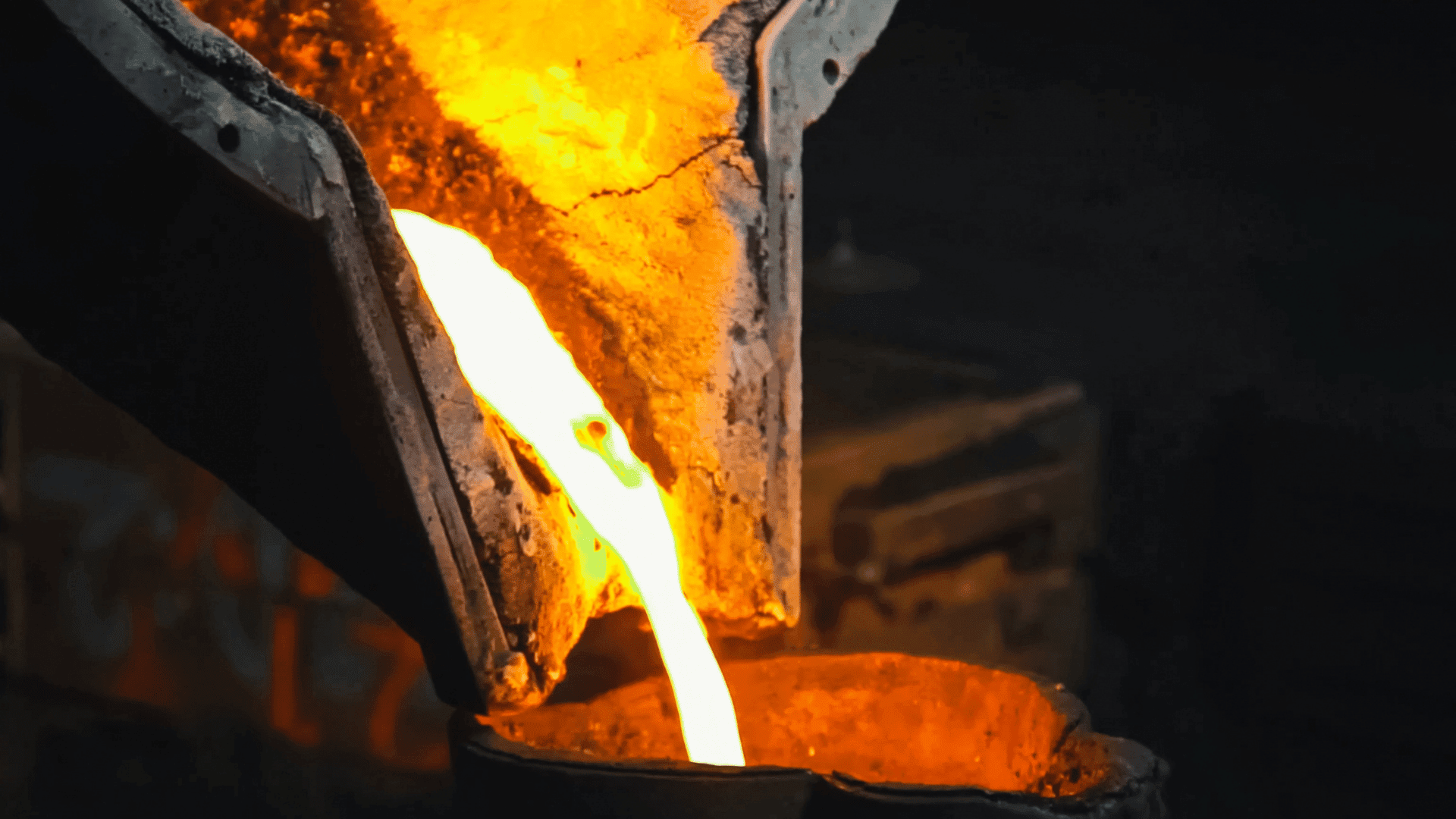
The International Energy Agency made a comparison I keep coming back to. It says a large AI data centre can draw as much electricity as an aluminium smelter. That comparison carries a lot of freight. Aluminium is one of the hardest industries in the world to decarbonise, and we have a century of evidence about where smelters get built, who pays for them, and what they run on.
Now, consider that if data centres are the new smelters, that makes the aluminium industry a valuable preview. And the preview says the energy cost curve, not the climate pledge, decides where the data centres go.
Aluminium-grade power
Aluminium has long been called congealed electricity. A smelter pushes an enormous current through molten alumina, around the clock, for decades. It cannot stop. If the power fails for long enough the metal freezes in the pots, and restarting is slow and very expensive. Electricity is 30–40% of a smelter’s costs, so every operator has spent decades hunting for the cheapest reliable supply.
What did they find? The International Aluminium Institute tracks it. In 2022, coal supplied about 57% of the electricity used in smelting worldwide, hydro 31% and natural gas 10%. Everything else, nuclear, wind and solar included, shared the last 2%. Hydro is why the industry has always chased rivers: primarily Norway, Quebec, Iceland, and Siberia. Gas is the Gulf, where the smelters sit on the gas fields. Wind and solar are a rounding error. Even in Australia, with some of the best sun and wind on earth, all non-hydro renewables together supplied about 5% of smelting electricity in 2023.
That is a stark reminder of how far non-hydro renewables are from solving this problem. Hydro works because it runs all day. Wind and solar don’t, and a smelter doesn’t care about the average. It cares about 3am on a still night.
Call it aluminium-grade power: firm, flat, and around the clock, at gigawatt scale. It turns out an AI data centre wants exactly the same thing.
The surprise demand
The energy transition was planned as an orderly affair. Advanced economies had decades of essentially flat electricity demand, so the job was to swap old generation for new, one plant at a time.
Data centres broke the plan. The IEA expects their consumption to more than double by 2030 to around 945 TWh, which is slightly more than Japan uses today. By then, US data processing is on track to use more electricity than all of its energy-intensive manufacturing combined, aluminium included. And the forecasts keep moving. India’s power ministry put data centre demand at 13.56 GW by FY32 in March 2026. By July it was 26.3 GW.
This is incremental demand, above and beyond the transition already underway, and it is aluminium-grade. Almost all of it will need new, greenfield energy infrastructure, because the incremental megawatt must come from somewhere. And the one renewable that has worked for aluminium is the one we can’t make more of. The best hydro sites were taken long ago, and what’s left is remote, slow to build and increasingly contested. Incremental hydro is scarce, and becoming more so. It looks more likely for new generations to be remote, wherever the coal, the gas, the sun or the wind happens to be.
The bell rang
For the first few years of the build-out, none of this mattered much. The race was for speed. That was the world I described in Speed to power: the scarce input was a grid connection, and whoever got powered up first won the customer. The money was easy because the neoclouds borrowed against their chips and built.
Then the bell rang. In October 2026, CoreWeave, the largest listed neocloud, was carrying more than US$51 billion of debt and obligations, the yield on its 2031 bonds had passed 15%, and its credit default swaps had moved into distressed territory. Evercore ISI’s trading desk said the market was basically saying “no more” to AI debt without operating cash flow behind it.
Capital moves in cycles, a pattern I traced in Reading the flow. The money doesn’t disappear. It gets fussy. From here a data centre gets built when it is bankable: an offtake agreement with a creditworthy hyperscaler, a feasibility study a lender believes, and a power cost that survives the spreadsheet. The party of speculative builds is over. Once lenders start counting, cost decides everything.
The cost curve
I first came across cost curves from one of the commodities analysts at BT. Cost curves are the standard way to think about any commodity. Line up every producer from least to most expensive, stack their volumes, and you have the curve. Price settles at the cost of the marginal producer. The bottom quartile makes money through the cycle. The top quartile closes in the downturn.
Now apply it to power. The delivered cost of a megawatt-hour has four parts: the fuel, getting the fuel to the power station, the power station itself, and the transmission line to the load. Renewables have no fuel bill, but to deliver aluminium-grade power they swap the fuel line for a firming line: overbuild, storage and backup. Stack every possible site on an energy cost curve and the bottom quartile is where the next bankable data centre goes. Usually that means next to the power rather than next to the city, because a long transmission line moves a site up the curve.
Financially, the next question is which sites sit at the bottom? The aluminium industry has already run the experiment.
Lesson one: the market test
This argument doesn’t need a cost study. Smelters have every reason to want the cheapest reliable power. If wind and solar (leaving hydro aside) could deliver aluminium-grade power more cheaply than coal, they would have replaced coal decades ago. But they haven’t.
Take the exception. Rio Tinto is repowering its Boyne smelter near Gladstone with wind, solar and batteries, and expects Boyne to be among the first aluminium smelters in the world underpinned by solar and wind. Among the first, after more than a century of smelting. Boyne needs up to 975 MW, which Rio itself says is equivalent to 3–4 GW of wind and solar, plus firming. The federal and Queensland governments are putting in A$1 billion each over ten years. And the contracted projects are expected to cover more than 80% of the smelter’s annual average demand. An average, not every hour.
Tomago, our largest smelter, tells the same story more bluntly. It uses around 12% of New South Wales’s electricity, and its coal-fired supply contract with AGL runs out at the end of 2028. In August 2026 the federal and NSW governments committed A$2.5 billion to a ten-year, below-market power deal to keep it open to 2038. The power goes fully renewable only from 2033, and until then it will draw on a New South Wales grid that still runs mostly on coal. Even with A$2.5 billion of public money, the bridge to renewables is built from coal.
Two smelters, A$4.5 billion of public support. It can be done, but at a price.
Now take the greenfield test, where nobody is locked into a legacy contract. Indonesia is building aluminium capacity right now, and nearly 10 GW of captive coal is operating or likely to be linked to it. It could use hydro, but that would take longer and cost more. Instead, it chose coal. Through a global lens, coal is the bottom of the energy cost curve for aluminium-grade power. The fuel sits beside the mine, the plant runs flat out, and nothing needs to be overbuilt or firmed.

Lesson two: nothing gets built without an underwriter
Australia learned this one the hard way. Our big smelters, Boyne (1982), Tomago (1983) and Portland (1986), were built on long-term power contracts underwritten by state governments through their electricity commissions, on terms the Australia Institute described as highly favourable. Tomago says so itself: the smelter was built “after a long term electricity contract was entered into with the then Electricity Commission of NSW”. Portland’s power was priced in line with the world aluminium price, which meant Victoria carried the price risk, at a cost later estimated in the billions. The state took the risk so the smelter could be financed. When the electricity market was deregulated, the underwriter left. Australia hasn’t built a new smelter since.
The demand didn’t go away. China built the capacity instead, at the bottom of the curve. In Inner Mongolia, smelters went up alongside their own captive coal plants, some of them subcritical, burning local coal. As I wrote in “Don’t be idealistic”, processing moves to wherever the energy is cheapest.
Hyperscaler credit is today’s state power contract. The bell just showed what happens to a build without one.
Lesson three: developing economies can’t afford luxury beliefs
Start with the region’s energy flow, because it is the one to understand. Indonesia and Australia are the world’s two biggest coal exporters, shipping 555 and 363 million tonnes respectively in 2024, close to 60% of all the coal traded on earth. China and India are the two biggest buyers, taking about half of all coal imports. The fuel at the bottom of the curve is dug up on our doorstep and burned in Asia’s power stations.
Now look at what Indonesia is doing with its share. Its GDP per capita is about US$5,000. Australia’s is more than ten times that. It is easy, from a rich country, to expect poorer ones to pay a premium for clean power. That is a luxury belief that Indonesia can’t afford, and it has shown this twice already.
In 2025, captive coal built for nickel processing reached 19.3 GW. The pipeline would take Indonesia’s captive coal past 31 GW, more than Australia’s entire coal fleet. Industrial developments with the right designation are exempt from the country’s 2022 ban on new coal plants. Looking at the industry now, and aluminium is following nickel. My bet, and I’ll flag it as a bet rather than a forecast, is that data centres are the next tenant.
India is more subtle. Its new rules require data centres to meet at least 80% of their annual consumption from renewables. But annual matching is accounting. At 3am, the electrons come from the grid, and the grid is coal.
Dirty tokens
We have been here before. By 2008, Chinese imports made up more than 30% of the Australian aluminium extrusion market. Australia has run anti-dumping cases against Chinese aluminium ever since, and every one of them was about price. None was about carbon. To put it bluntly, we bought the dirty aluminium because it was cheaper.
The world will buy dirty tokens for the same reason, and tokens are harder to stop. Europe’s carbon border tax applies to goods; emissions from exported digital services sit outside it. A container of extrusions passes through a customs house. A token arrives by fibre, as I explored in The molecule or the intelligence. There is no border to tax it at.
However, there are limits. Training runs and batch inference can be done anywhere; latency-sensitive work and regulated data can’t. But the mobile share is large and growing. My second bet, again a bet and not a forecast, is that coal-fired compute in Asia makes the West reconsider coal. Right now, coal sits at the bottom of the curve, and a cost-conscious world notices.
Australia is in an odd spot. We have world-class coal. We ship it to Asia’s power stations, and the politics won’t let us burn it at home. We also have gas, and gas is the allied, less-dirty position near the bottom of the curve. Whether we use it is the question I keep coming back to.
What it means for an angel
Kerr Neilsen’s advice to me on the BT ferry still applies: don’t be idealistic, work out what is going to happen. Hoping buyers will pay a premium for clean tokens is a losing strategy. Clean power wins when it is cheaper than coal on a firm, 24/7 basis, and not before.
I expect the next decade to be spent staring at the cost curve for aluminium-grade power. There is no silver bullet that rewrites it. Instead, there are hundreds, probably thousands, of incremental ideas, each pushing some part of the curve a little further down. And that applies to the clean and the dirty parts of the curve alike.
Some ideas will make clean power firmer: storage that shrinks the overbuild, flexible load, smarter firming, anything that would make the next Boyne or Tomago possible without billions of public money. Some will make dirty power cheaper and cleaner: better fuel logistics, more efficient plants, less waste. Some will avoid the transmission line by putting generation behind the meter. And some will cut the power a data centre needs in the first place, which is the logic behind our investment in Enaxiom.
It is the pattern I described in After the machines: a hundred 1% effects rather than one big one. On a curve this size, the small effects aren’t small. One per cent of the IEA’s 945 TWh is around 9 TWh a year. Those are the angel deals, and the impact can be massive.
The question I put to every founder in this space is the same: where does your customer sit on the energy cost curve, and does your product move them down it?
The curve tells you where the industry goes. It doesn’t tell you which company wins. Which is the argument for many small bets rather than one big one.
Richard Moore is co-founder of MooCoo Ventures, an angel syndicate that co-invests alongside Brisbane Angels, one of Australia’s most active angel groups. He has made over ninety personal angel investments since 2013.
moocoo.vc
DISCLAIMER: The information provided is for general informational and educational purposes only and should not be construed as financial, investment, or legal advice. Any decisions you make based on this information are your sole responsibility. You should consult with a qualified financial advisor or other professional before making any financial decisions. Past performance does not guarantee future results.