
Somebody in Osaka asks an AI model a question. How the answer gets there is quite the journey.
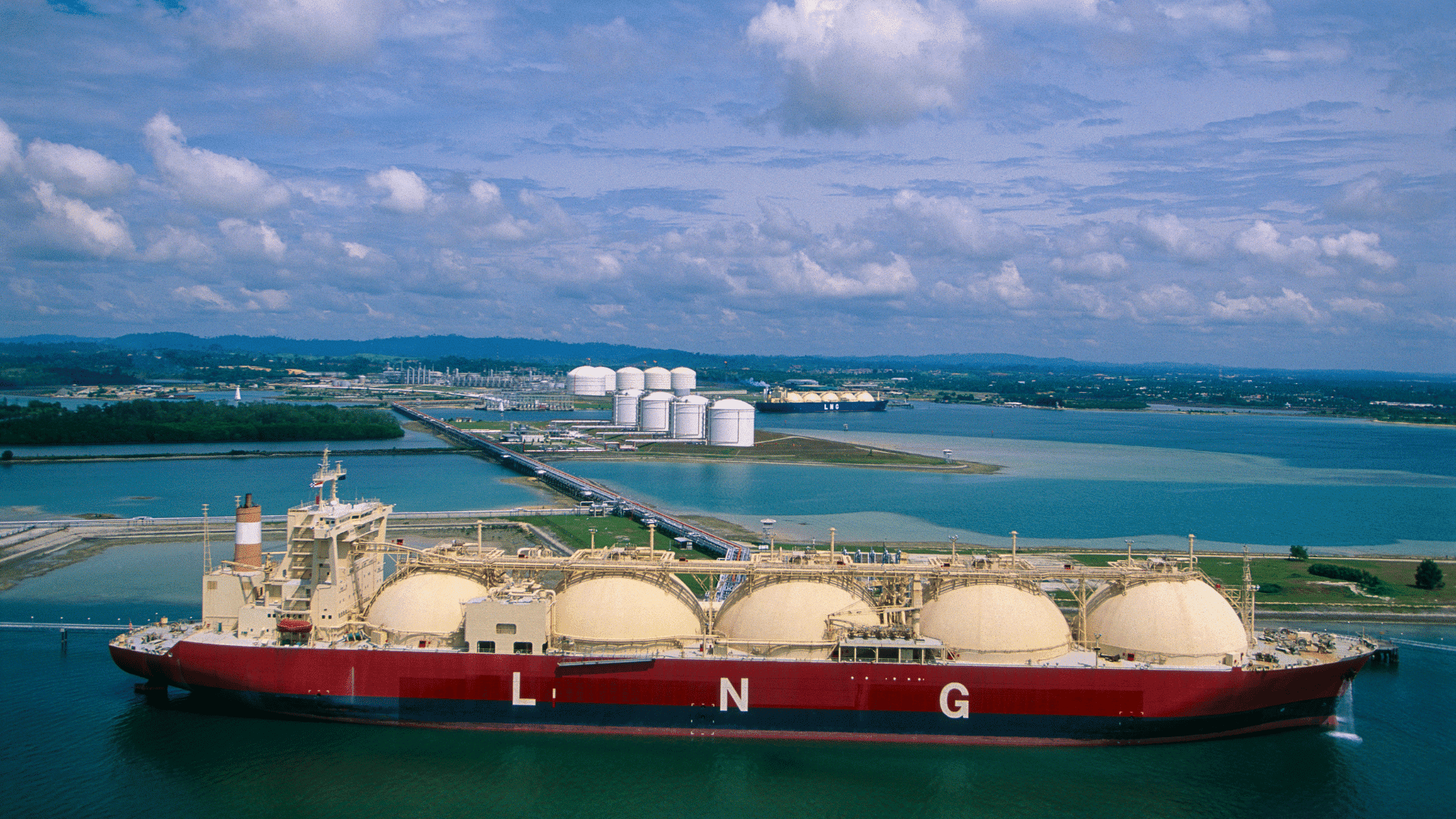
Gas is drawn out of a coal seam a few hundred metres under a paddock west of Chinchilla, which mostly means pumping the water off the seam until the methane comes free. It runs through gathering lines to a field compressor, then to a central processing plant where it’s dried and compressed. It’s piped a few hundred kilometres east to Gladstone through one of the largest-diameter buried pipelines in the country. At Curtis Island it’s chilled to minus 162 degrees until it turns liquid and collapses to about a six-hundredth of its volume. It’s loaded onto a tanker. The tanker sails six or seven thousand kilometres north. At the other end it’s warmed back into gas, put into another pipeline network, burned in a power station, and the electricity is carried across a grid to a building full of racks.
Then it becomes a sentence.
A dozen steps, two of which involve changing the physical state of the molecule and one of which involves a ship.
There is another way. Burn the gas near Chinchilla, firm it with solar and storage because nobody is building a data centre on gas alone. Run the workload at Dalby and send the sentence to Osaka down a fibre.
That’s it. That’s the whole alternative. Exporting intelligence rather than the fuel that produces it.
I wrote in the last post about why a Singapore developer is proposing to build Australia’s largest data centre on a cattle feedlot 250 kilometres from Brisbane. The answer was speed to power: the scarce input is no longer fuel but the time it takes to get connected. Nobody has said who that particular facility would serve, though Anthropic has signed an agreement to use part of the data centre. To be fair, a campus that size in Australia has plenty of domestic and regional demand to satisfy without exporting a single token. But the location is the tell, and once compute starts moving toward energy at all, an energy exporter gets a choice it has never had before.
The discount that never lifted
Australia has been having a version of this argument since the 1960s, and losing it.
We dig up bauxite and someone else makes the aluminium. We ship iron ore and someone else makes the steel. Every decade or so a government or an industry body makes the case for moving downstream, and the case is always intellectually sound yet dies in the same place. Value-adding raises the value of each tonne, but you still have to move the tonne, and we are a long way from everybody. The freight bill eats the margin. Distance is the permanent Australian discount, and no amount of policy has ever repealed it.
I made the pessimistic version of this argument about mineral processing in a previous post, where I don’t think the smelters come back. And I still don’t.
This time, the discussion is very different. Exporting intelligence has no freight bill. The output of a data centre weighs nothing, takes up no hold, and waits for no berth. For the first time there is an energy-intensive industry where we can convert cheap energy into something far more valuable, and the distance penalty doesn’t apply. Australia’s oldest economic disadvantage has an exception, and it arrived from an unexpected direction.
Cheap energy, though. That’s the assumption doing the work, and it’s the one everybody in Queensland will immediately object to.

Expensive compared to what?
The objection is correct as far as it goes. Queensland has an enormous gas resource and Queensland does not have cheap gas. Three LNG plants at Curtis Island connected the east coast to the world price, and once a molecule can be sold internationally, the domestic buyer pays roughly what the international buyer would have paid. Abundance and cheapness are different things. The resource is under our feet, and the price comes from somebody else’s demand.
The arithmetic is worth having in front of you. A modern combined-cycle plant turns gas into electricity at roughly 55% efficiency, so it needs about six and a half gigajoules per megawatt hour. At $7 a gigajoule the fuel alone costs around $46 a megawatt hour. At $14, about $92. At $20, roughly $131. Nothing else has been counted; not the turbine, network, or capital, and certainly not the GPUs.
Those are uncomfortable numbers, and they are why the domestic gas debate has been so bitter for a decade.
But look at how the domestic price is set. The netback is the world price minus the cost of liquefying the gas and shipping it. That’s the whole logic of export parity: a Queensland seller will accept from a local buyer whatever a foreign buyer would have paid, less what it costs to get it to them.
Previously, the United States was the benchmark everyone reached for. American gas has traded well below world price for two decades, making Texas shorthand for cheap gas. The gap exists because the export capacity was the constraint, not because the gas was free. Now take the constraint away: record liquefaction capacity coming on, a domestic AI build wanting the same molecules, plus reshoring and electrification. If the swing producer gets squeezed in any direction, the marginal American molecule starts being worth what an export buyer would pay for it.
Which means the Queensland buyer is structurally cheaper than the Japanese buyer of the identical molecule, by exactly the cost of chilling it to minus 162 and putting it on a boat. Not because of anyone’s goodwill, but because of arithmetic.
The domestic gas debate has spent a decade comparing Queensland with Texas. The more useful comparison is with Osaka, at the far end of the route this piece began with. Every gigajoule that reaches Japan has been chilled, shipped six or seven thousand kilometres, and warmed again, and the buyer pays for each step. And an energy importer is a price taker forever. It pays the world price plus freight, and no amount of grid efficiency or policy design gets it underneath that floor. The very mechanism that makes Queensland gas expensive relative to some imagined closed domestic market is the mechanism that guarantees it stays below the delivered price in Tokyo, Seoul, and Singapore.
That advantage is real and it’s also bounded. Liquefaction and shipping run to something like three to five dollars a gigajoule, so twenty to thirty-odd dollars a megawatt hour of fuel cost. Material, not decisive, and easily swamped by capital costs, chip access, latency or network charges. It won’t win an argument on its own. It just means the argument is winnable, which is more than has ever been true of an Australian downstream processing pitch before.
What stays home regardless
The other obvious objection is that countries won’t let their AI move offshore, and that one is right too.
Every serious economy will build its own compute. Defence, intelligence, health records, government systems, regulated financial data, critical infrastructure, and more. None of that is going to sit in a paddock in another hemisphere no matter what the electricity costs. Anything genuinely latency-critical stays close to the user for reasons that have nothing to do with price.
I’m not arguing against any of that. Sovereign compute gets built, and it gets built at whatever the local system charges.
The case for exporting intelligence only ever applied to what’s left over. Training runs. Batch inference. Synthetic data. Scientific simulation. Rendering. Model experimentation. Work that doesn’t care where it happens and won’t notice another forty milliseconds. That category is large and growing, and it’s the only category where price decides the address. If you think the residuals are small, this whole thesis is uninteresting. I think it’s large, and I’d put that down as my reading rather than a forecast.
And the cost curve is lifting
There’s a second force, and the tidy version of this argument leaves it out.
If compute relocates toward cheap energy, some incremental LNG demand never materialises. That’s a ceiling on how bullish AI can be for internationally traded gas volumes. But the marginal molecule sets the price, and in a high-demand world the marginal molecule gets harder to produce.
Australia already made that transition, involuntarily, when Curtis Island was built. We designed our export agreements around global prices, and the domestic market has lived with the consequences ever since. The US would be walking the same road with better geology and a lot more time, but the destination is the same one.
If that happens, two things follow. Australian LNG looks better rather than worse, because a lifting cost curve is good news for an existing low-cost producer. And the gap between Queensland and Texas closes from underneath, while the gap between Queensland and Osaka stays exactly where it is, because that one is set by freight rather than by geology.
I’d flag all of that as my own reasoning rather than a forecast. Henry Hub has stayed stubbornly cheap for twenty years, and pipelines and permits are constraints of their own. But we are closer to that point than we have been, and the direction of travel is not ambiguous.
Which one does Queensland sell?
None of this is a prediction that Queensland will become an AI export economy. Most of the world’s compute will keep being built where the chips, the capital, and the customers already are. As I said in The Multiplex Moment: the interesting money in a boom rarely sits where the boom is loudest.
The point is narrower and I think more durable. For a hundred and fifty years the only question Australia got to ask about its energy was how much to dig up and who to sell it to. The value-added version of the question was always available and always uneconomic, because the answer had to go on a ship.
There’s now a version where it doesn’t. Exporting intelligence is the first value-add this country has been offered that doesn’t need a berth. Whether we’re any good at answering the question is a different matter, and the honest position is that we haven’t been.
But the choice is on the table, and it wasn’t before.
Next post: who builds the companies that make it work, why the Pilbara is the precedent, and why the founders are already here.
Richard Moore is co-founder of MooCoo Ventures, an angel syndicate that co-invests alongside Brisbane Angels, one of Australia’s most active angel groups. He has made over ninety personal angel investments since 2013.
moocoo.vc
DISCLAIMER: The information provided is for general informational and educational purposes only and should not be construed as financial, investment, or legal advice. Any decisions you make based on this information are your sole responsibility. You should consult with a qualified financial advisor or other professional before making any financial decisions. Past performance does not guarantee future results.