
In March 2022, someone at Coles changed a number in an internal document. The company’s own rules said a product had to sit at its new, higher price for twelve weeks before it could go back on a “Down Down” promotion. That waiting period was cut to four.
On 14 May 2026 the Federal Court found that Coles had misled customers with those promotions, in breach of the Australian Consumer Law. Justice O’Bryan described the change as a race to the bottom, made under competitive pressure from Woolworths. Penalties haven’t been handed down yet. Woolworths is defending similar proceedings.
What I couldn’t understand is why a rule that existed, that formed part of the company’s own policy and guidelines, got overridden by a commercial decision made by someone sitting in marketing. A month earlier the same court had ordered Emma Sleep to pay $15 million over strikethrough pricing, finding the conduct came out of a deliberate marketing strategy that senior management chose not to look at too closely.
The answer, I think, is that nobody in either business was confused about the rules. The rules just lived a long way from the moment the work actually gets done.
And the people who are supposed to catch the problem are reviewing hundreds of assets a month by hand. Neosframe reports that production and approval cycles within enterprise businesses can commonly run anywhere from two to six weeks: legal reviews the versions, brand reviews legal’s edits, and the campaign either goes out late or goes out unchecked. Both cost money.
That’s the problem Neosframe was built to solve, and it’s why MooCoo Ventures has backed the company’s round alongside Future Now Capital.
One brief, every version, checked on the way out
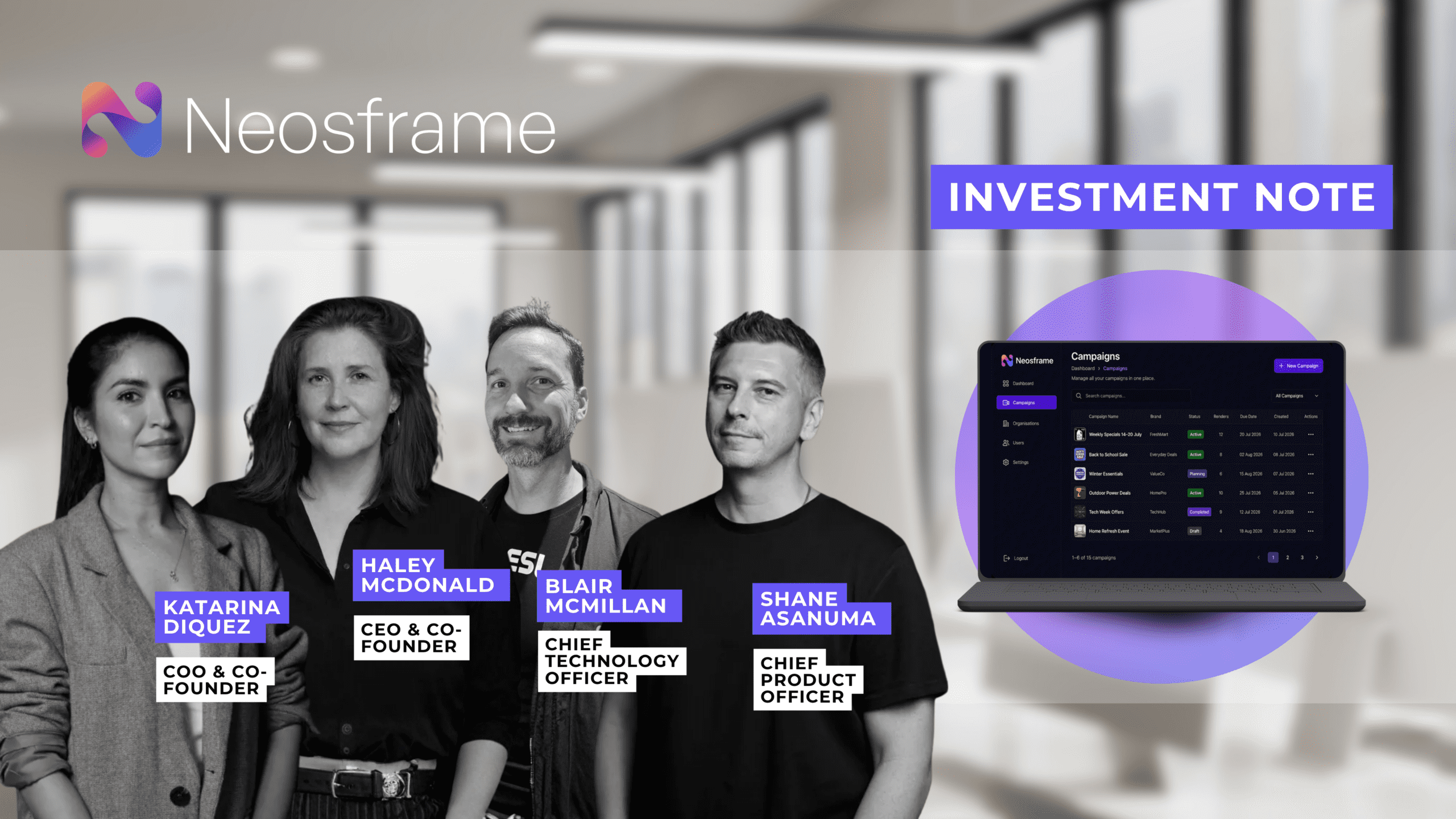
Neosframe is a Brisbane enterprise platform that takes a single creative brief and produces every version a campaign needs (every format, price point, region and channel), then runs each one against the brand and regulatory rules before it leaves the building.
The mechanism is what interested us. Most creative automation tools generate assets quickly and leave compliance as a separate review step downstream. Neosframe puts a proprietary compliance engine inside the production workflow, so the rules get enforced while the asset is being made rather than checked afterwards. Approval routing, audit trails, version control and sign off are all built in, which means the record of who approved what just accumulates as people do the work. Nobody has to reconstruct it later.
The company is careful about where AI sits in all this. Its own line is “AI for speed, never for decisions”. Generative models handle asset production, voice and scripting, and the compliance layer supervises them, so AI never gets to decide whether an ad is lawful.
I read that as positioning at first, until I thought about who’s actually buying. If you’re a wagering or a financial services brand, that’s the whole reason you can put the product into production.

Why we invested
Our thesis is narrower than “regulation is increasing”, which is true of almost everything and predicts nothing.
What Neosframe has spotted is that compliance guardrails written as policy fail in a specific and fairly predictable way. They can bend under commercial pressure, because a document can’t say no. A guardrail encoded in the software that produces the asset behaves differently. It doesn’t get quietly amended in March because a competitor moved. The fair question is whether that’s a real structural argument or just a hopeful one. Coles answers it about as cleanly as you could ask for.
The second reason is the shape of the business underneath. Neosframe sells an enterprise licence to head office, and then a self serve portal lets individual franchisees produce their own broadcast grade video from templates that head office has already approved and locked. Each enterprise deal therefore unlocks hundreds of paying users without a matching increase in sales effort. Australia has more than 96,000 franchise units and the US has over 750,000. The existing franchise marketing platforms sorted out print and static digital years ago, but none of them has cracked video.
That layer is the more valuable half of the business and also the less proven half. It ships in Q4 2026, and franchisee take up at scale is untested beyond pilots, so we’ve underwritten it as upside rather than as the base case.
We should be equally honest about the window. Management estimates two to three years before a serious competitor closes the gap. We think that’s the right order of magnitude, though it isn’t a comfortable one. IntelligenceBank is Australian, well capitalised and already selling compliance software into regulated industries. It doesn’t have broadcast video today and could buy it. The moat here is the integrated stack plus a compliance rules library that gets deeper with every deployment, and both of those compound, but only if the company signs reference customers quickly. Execution speed over the next eighteen months is really what we’re backing.
Why this team
Three of the four founders were members of the original team at Neds, the wagering business that went from launch to a $90 million exit to GVC/Entain in eighteen months.
The exit is the headline, but what we kept coming back to was where they learned the job. Wagering is the most heavily regulated advertising category in Australia. Katarina Diquez ran creative operations there through that whole period, so she has already lived the exact problem Neosframe sells into, at high volume, under real scrutiny, with no room for a two-week approval cycle. Shane Asanuma, now Chief Product Officer, was on the same core team.
Haley McDonald came at it from the other direction. She spent a decade building 3P Studio into one of Australia’s more respected post-production houses, which means she ran the production pipeline that Neosframe is now automating. Founders who automate an industry they’ve only studied tend to build for the version of the workflow that shows up in a case study. Haley is automating her own.
Blair McMillan, the CTO, has taken two prior ventures from startup through acquisition and has a background in secure enterprise architecture for regulated industries.
It’s a small team for the roadmap in front of them, with no commercial or customer success leadership yet beyond the founders. That gap needs closing this year.
What the round tells you
Neosframe’s anchor enterprise customer is Entain AU/NZ, the same group that acquired Neds. Entain Group (Australia & New Zealand), selected the platform to manage creative production across its multi-brand portfolio, citing compliance automation and workflow efficiency as critical factors in a heavily regulated industry.
Future Now Capital is leading the round; the firm is a Sydney-based enterprise SaaS specialist whose portfolio includes Finder, EncompaaS, Year13, and Local Measure. Two things make its involvement useful beyond the cheque. This is the first early stage deal out of a new fund, so the diligence was heavier than a seed round would usually attract and looked more like what a scale up would face. Future Now also has the capacity and the stated intent to write between $1 million and $10 million into the next round, and a lead that can fund the Series A is worth a good deal more than a lead that can’t.
Interested in deals like this?
Neosframe is built on a specific observation about how big organisations fail at compliance, run by people who watched it happen from inside one of the most scrutinised categories in the country. That kind of ground-level insight is what we look for.
If you’d like to explore upcoming opportunities, visit moocoo.vc/investment-opportunities or get in touch.
moocoo.vc