In stroke medicine, there’s a brutal paradox: the treatments work, but the system designed to deliver them often fails. We don’t lose patients because we don’t know what to do. We lose them because we can’t diagnose fast enough to act.
Stroke care is one of the clearest examples of this. Every minute matters, yet the imaging required to make the right decision is slow, immobile, and often unavailable at the point of care. By the time a scan happens, the window for effective treatment has often closed.
That’s why we invested in Wellumio.
MooCoo Ventures is backing Wellumio, a New Zealand-based medtech company building portable, MRI-quality brain imaging for stroke diagnosis at the bedside. The round is led by Nuance Capital, alongside Brisbane Angels and a strong group of experienced New Zealand deep tech investors.
For us, this means backing a company with the potential to redefine how stroke care is delivered, globally.
What Wellumio does
Stroke kills brain tissue at a rate of roughly 1.9 million neurons per minute. The clinical challenge is simple but unforgiving: determine whether a patient is having an ischemic stroke (a blockage) or a haemorrhagic stroke (a bleed). The treatments are not just different, they are opposite.
Today, that decision depends on CT or MRI imaging. In practice, that means moving the patient, waiting in a queue, and losing critical time. According to Wellumio, fewer than 5% of patients receive treatment within the first hour. Missing it means missing the window where intervention has the greatest impact.
Wellumio collapses that delay.
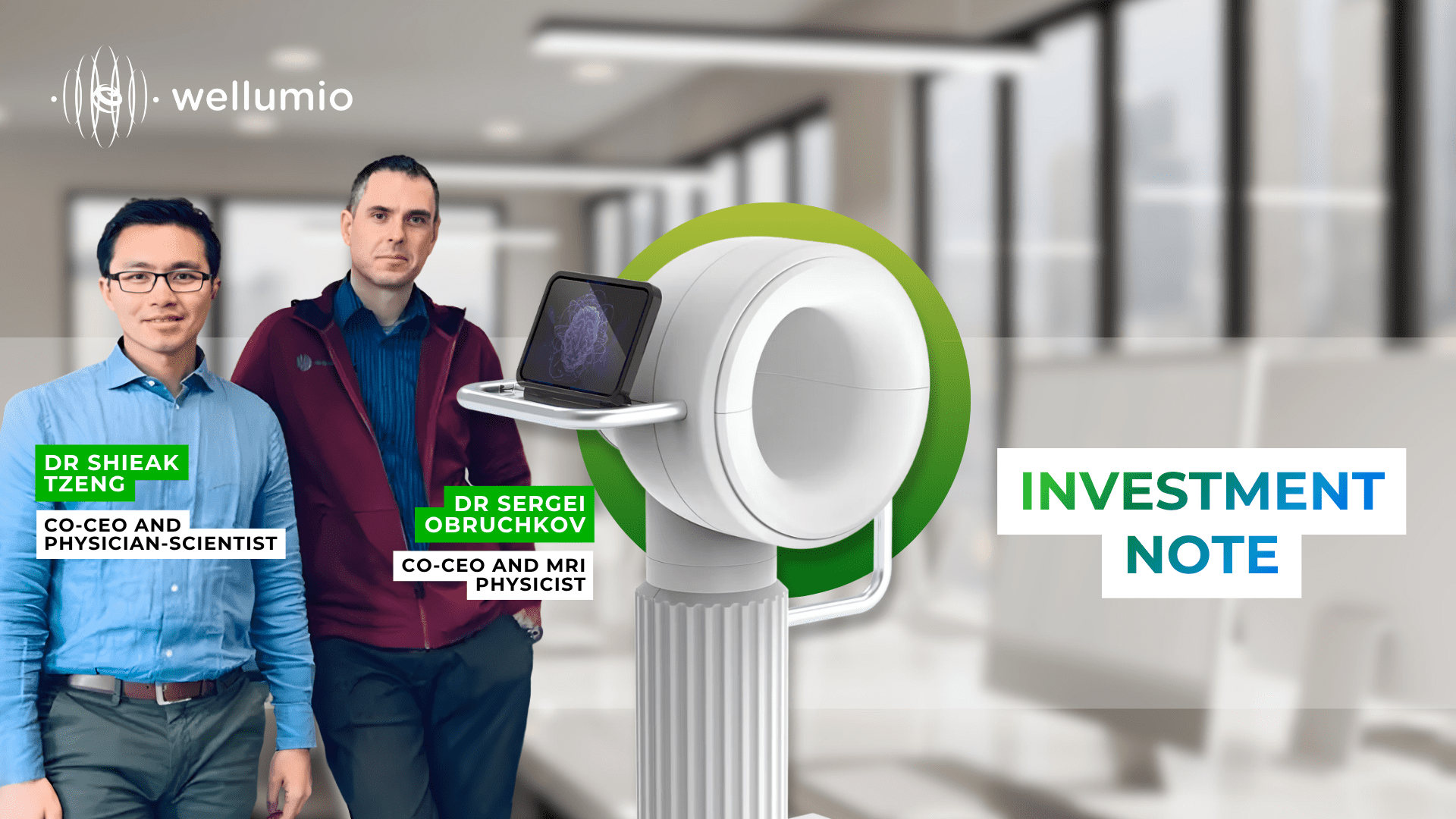
Its device, Axana, is a 50-kilogram, battery-powered scanner that brings brain imaging directly to the bedside. No shielded room, contrast agents, or cryogenics. Just rapid, point-of-care diagnostics.
At its core is Pulsed Gradient Field Mapping (PGFM), a novel magnetic resonance technology developed by co-founder Dr Sergei Obruchkov. It maps the biomarkers clinicians need – ischemia, haemorrhage, perfusion – in approximately four minutes. The company secured a US patent for this technology in December 2025.
Just as importantly, the product is designed to fit into existing workflows. Axana produces clear, binary outputs and integrates with telestroke platforms, enabling remote neurologists to make immediate decisions.
If it performs as intended, the impact is meaningful: faster treatment, better outcomes, and lower system costs, including an estimated 11 additional months of disability-free life per patient and significant reductions in ICU time and hospital spend.

Why we backed Wellumio
From the first conversation, we felt like this went beyond innovation. It felt like a missing piece.
What stood out immediately was how visible the problem is once you look for it. Stroke care isn’t constrained by knowledge, it’s constrained by logistics. The diagnostic bottleneck is hiding in plain sight, locked inside machines that were never designed for the urgency of emergency medicine.
Wellumio flips that equation. Instead of moving the patient to the scanner, they bring the scanner to the patient. This sounds simple, but it isn’t. It took a specific combination of skillsets to find the right solution, and that’s exactly what brought us to the team.
The team
Our discussions with Shieak, Sergei and the team at Nuance Capital made it clear this was a deeply considered solution built from both sides of the problem.
Dr Shieak Tzeng is a physician-scientist and co-CEO who has experienced these decisions firsthand as a clinician, where delays carry permanent consequences. His background as a practising doctor means he understands the problem as both an engineering challenge and a human failure that plays out in emergency departments every day. That perspective shapes how Wellumio is building its product and its relationships with hospital networks, designed as a clinical decision tool that fits into real-world workflows.
Dr Sergei Obruchkov brings the scientific depth. As the inventor of Pulsed Gradient Field Mapping (PGFM) and co-CEO alongside Dr Tzeng, he has developed a fundamentally new approach to magnetic resonance imaging. The patent granted in December 2025 reflects the depth and novelty of what he has built over many years of dedicated research.
That combination matters. Healthcare rewards solutions that work inside the system and deliver under pressure. The pairing of a clinician and a physicist at the top of a medtech company reflects a shared conviction that the science and the medicine have to move together, or neither will get anywhere.
What ultimately gave us conviction was the alignment across three things: a real and urgent clinical problem, a technically differentiated solution, and a team capable of navigating both the science and the healthcare system.
This is not a company trying to disrupt from the outside. It’s one built from within the constraints of care delivery, and that’s exactly why we think it has a shot at changing it.
The opportunity
The market Wellumio is entering is large and structurally underserved. According to the founders, in the US alone, there are approximately 1.1 million suspected stroke presentations annually in outpatient settings, alongside a further 1 million patients requiring neurological monitoring post cardiac surgery.
Wellumio is initially targeting community and critical access hospitals. Traditionally, these are settings where access to advanced imaging is limited and delays are most acute.
The competitive landscape highlights the gap. Portable CT systems still require shielding and expose patients to radiation. Low-field MRI systems remain too large and slow for emergency workflows. Alternative modalities such as microwave and bio-impedance lack the ability to measure the metrics that determine treatment decisions such as perfusion and tissue viability.
If PGFM delivers clinically, Wellumio occupies a position no current alternative can reach.
The company’s go-to-market strategy is pragmatic: deploy into telestroke networks, start with hub hospitals, generate outcomes data, and expand through existing clinical pathways. Partnerships with Nicolab and Meytec provide immediate access to established stroke networks.
Initial focus is ANZ and the US, with Europe to follow.
Interested in deals like this?
MooCoo takes a deal-by-deal approach, investing alongside co-investors and syndicate members who bring genuine strategic value beyond capital.
To explore upcoming opportunities, visit moocoo.vc/investment-opportunities or get in touch.