

I have been involved in angel investing for over 20 years. My early experience taught me that success in this space requires patience, pattern recognition, and a disciplined approach to diversification. While early-stage investing has always evolved with the market, the past five years have seen accelerated change driven by new funding models, sharper founder talent, and increased investor sophistication.
For those of us who specialise in early-stage deals, it’s an exciting time. I can see several strong trends emerging, and I’d like to share my vision for where early-stage investing is heading next.

From mathematician to prolific investor
My outlook on the future of early-stage investing is informed by extensive participation in this space. With over 30 years of experience across investment banking, funds management, and early-stage ventures, I’m one of Australia’s most active angel investors. I started my career as a mathematician in finance pricing derivatives in Sydney in the late ’80s, and spent seven years at BT Funds Management, where I led Australian equities and derivatives trading. In the ’90s, I built and led an equity capital markets business during the dot com boom.
After moving to Brisbane in 2000, I became CEO of Dark Blue Sea, scaling it into the second-largest professional domain name holder globally. Since 2013, I’ve been a committed member of Brisbane Angels, sitting on the deal screening committee and supporting founders with mentoring, funding guidance, and strategic advice. In 2021, I was awarded the Most Active Investor in Australia and my angel math approach has been adopted by many at Brisbane Angels to guide their investments.
I focus on capital-light startups with high margins and scalable business models, especially in software, SaaS, cloud, and internet. I’m looking for 10x return potential, and I assess every deal through the lens of capital markets and investment banking: can it raise follow-on funding, and can it exit big?
I’m now I’m launching MooCoo Ventures with Co-Founder Brian Cook (hence the name ‘MooCoo’, a portmanteau of our two surnames) to give other sophisticated investors access to the kind of deals I’ve been backing for years.
Let’s discuss the trends I see shaping angel investing, now and into the future.
The flight from public capital to private capital
In recent years, we’ve seen a clear and accelerating shift: capital is moving away from public markets and into private ones. The reasons are obvious to those paying attention. Public markets have become increasingly volatile, overregulated, and saturated with institutional money chasing incremental gains. Meanwhile, the real innovation, and the huge returns, are happening earlier, in the private space.
Investors are no longer content to wait for companies to list. Early investors capture much of a startup’s value well before it reaches IPO. That’s why more capital is now flowing into venture capital, private equity, and particularly angel investing.
I’ve run the numbers. Of all the asset classes I’ve considered, angel investing shows the highest return potential. While risk/return data related to angel investments is somewhat difficult to access, venture funds (a proxy for angel investing) provided the highest returns (and risk) vs several other asset classes (see image below). It’s not without risk—this is the sharp end of the stick—but when approached with discipline, diligence, and diversification, the outcomes can be extraordinary. Our own portfolios reflect that: over 100 early-stage investments, with IRRs north of 20%, and multiple exits delivering 10x–50x returns.
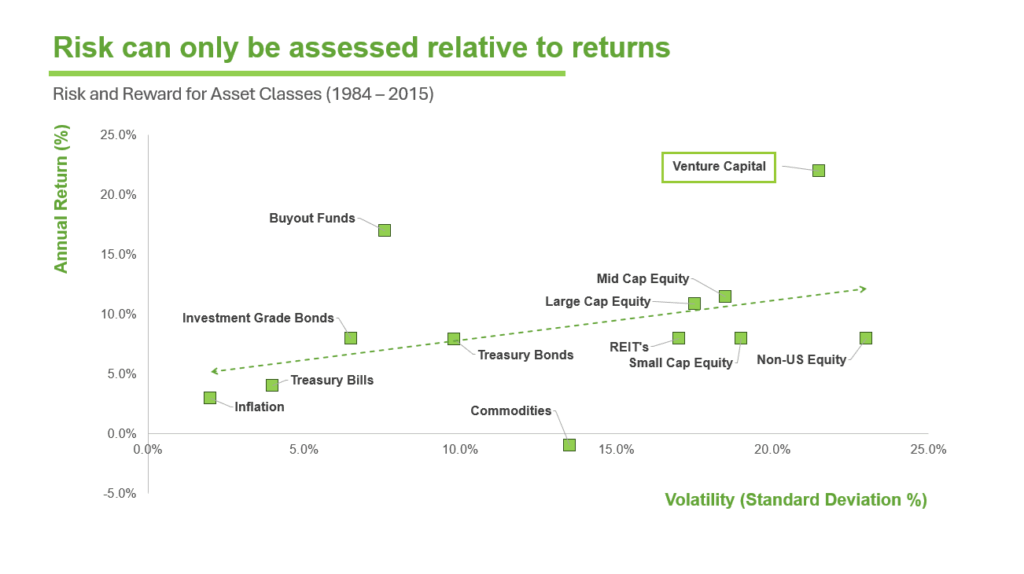
This flight to private capital isn’t a fad, it’s a strategic recalibration. Sophisticated investors want access to earlier deals, higher potential, and the kind of asymmetric upside that public markets no longer offer. With angel investing, you’re not just allocating capital—you’re propelling innovation and backing the next generation of category-defining companies.
How software (and AI) is still eating the world
It’s impossible to discuss innovation without discussing AI. But let’s go back to Marc Andreessen’s now iconic 2011 blog post about the future of software. In it, he predicted that over 5 million people would own a smartphone by 2021. He was close – in 2021, there were over 6.1 billion smartphone subscriptions worldwide and that number is expected to rise to 9 billion total subscriptions by 2030. These figures illustrate why Andreessen was so bullish about software and wholesale digital transformation.
Jump to now and AI is rapidly transforming modern SaaS businesses by driving efficiency, personalisation, and smarter decision-making. AI is helping SaaS platforms deliver more value with fewer resources, making product features more adaptive and data-driven. For SaaS founders and investors alike, AI isn’t just a feature, it’s becoming a core differentiator in competitive markets, accelerating growth and reshaping what users expect from modern software platforms.
Smart investors can build wealth by recognising the advantages delivered by generative AI and embracing businesses that harness this technology effectively.
The role of Moore’s Law
In the 1960s, Gordon Moore, co-founder of Intel, suggested that the number of semiconductors on a chip would double every two years. This phenomenon was coined Moore’s Law and has been applied to test the growth trajectory of technology businesses ever since.
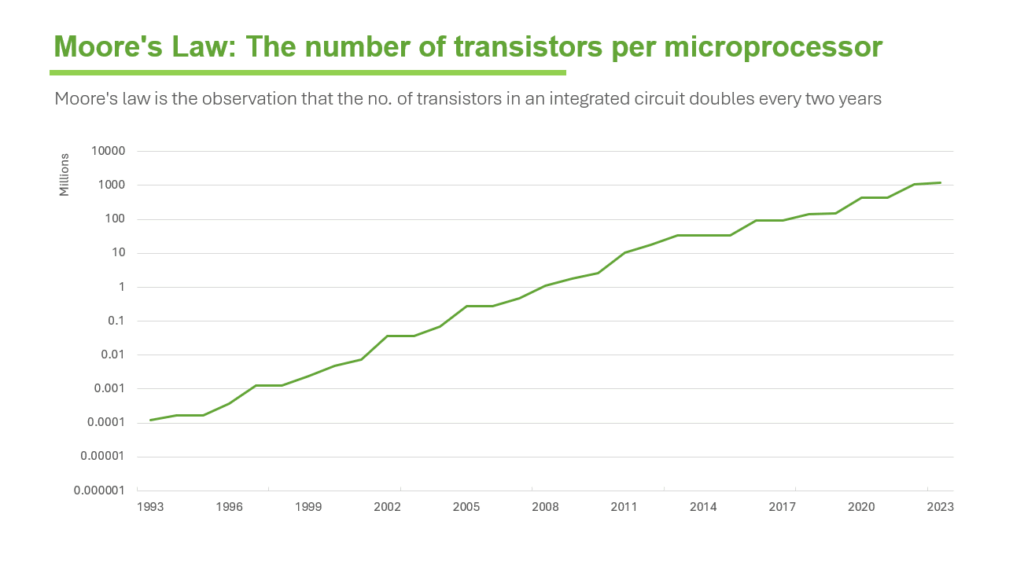
Surfing the Moore’s Law wave of technology adoption is a variation of traditional growth and/or momentum investing. If a company can double its revenue every year for the next few years, it might be able to justify doubling its valuation every year. The problem is that people are not good at understanding exponential growth. As an investor in emerging technology, considering where the industry might be in 5 to 10 years’ time (i.e. looking at it through the Moore’s Law lens) is prudent. If an industry is growing at 15%+, this means there is plenty of room for a new company to double/triple its revenue every year.
The advantage of lean businesses
Choosing capital-light and people-light business models has multiple advantages. These ventures are designed to scale without the traditional overheads of large teams or hefty infrastructure costs. Instead of investing in factories or headcount, founders focus on product, distribution, and revenue.
From an investor’s perspective, this means lower burn rates, faster time to market, and more runway to experiment and iterate. It’s a strategic way to reduce risk while still chasing meaningful upside. SaaS, fintech, and AI-enabled platforms are strong examples, delivering value through automation, scalability, and minimal operational drag.
For angel investors looking to back the next breakout success, capital-light, people-light startups offer an attractive formula: lean teams, high margins, and the potential to rapidly grow with relatively modest funding.
The future of early-stage investing
With these considerations in mind, it’s clear that all investors need to consider angel investing as an option for their portfolio. Private capital is where investors can find the most value and find the highest return potential. AI-powered SaaS businesses are attracting savvy investors who appreciate their potential for accelerated growth, as projected by Moore’s Law. Finally, I see an increasing preference for the strong returns of investments in capital-light and people-light startups.
If these prospects sound appealing and you’ve mastered traditional investing, this is your next frontier. MooCoo Ventures can help you find your next big win and access exciting investment opportunities – deal by deal.
www.moocoo.vc