

Angel investing and venture capital often get grouped together in conversations about early-stage funding, but they operate in distinct ways at different stages and offer very different opportunities for investors. Whether you’re a sophisticated investor looking to diversify your portfolio or curious about how to get closer to the kinds of returns venture capitalists enjoy, understanding the differences between these two paths is essential. In this blog, I’ll discuss how angel investing differs from venture capital, how you can get involved, and why more investors are turning to angel investing for potentially higher returns and more direct impact.

How do angel investors differ from venture capitalists?
Angel investors are typically individuals deploying their own money into early-stage startups, often in pre-seed or seed rounds. These investors are usually high-net-worth individuals with a passion for innovation and a tolerance for high risk. Their involvement is often personal and strategic, bringing not only capital but also experience and networks.
Venture capital, by contrast, comes from institutional funds that pool capital from many sources (e.g. pension funds, family offices). VCs generally invest at later stages, such as Series A and beyond, when the startup has some traction. VC firms are usually more hands-on in a formal capacity, often requiring board seats and imposing strict governance.
The biggest distinction lies in flexibility. Angels can act quickly and invest based on their own conviction, while VC firms move through formal processes and require internal approvals. This nimbleness gives angel investors access to deals before they hit the VC radar.
How to get involved in angel investing
Getting started with angel investing doesn’t require you to be a Silicon Valley insider. In fact, many sophisticated investors across Australia and globally are entering the angel space through structured syndicates, angel groups, and investment platforms.
Step one is to meet the legal definition of a sophisticated investor. In Australia, this generally means having net assets of $2.5 million or a gross income of $250,000 for each of the last two financial years. This requirement ensures that investors understand the risk and have the financial backing to absorb potential losses.
Next, decide how much capital you can allocate to angel investments. Typically, investors allocate 5-10% of their portfolio to this asset class. Within that allocation, diversification is key. Angel math tells us that you need at least 20-25 investments to improve the odds of a profitable outcome. This can take time, so building a portfolio steadily over several years is the best approach.
Joining a syndicate backed by experienced investors can fast-track your involvement. These groups source, assess, and often co-invest in high-potential deals, removing much of the burden for new investors. The shared expertise and access to vetted deals dramatically increases the likelihood of a successful outcome.
Angel investing is hands-on, intellectually stimulating, and surprisingly accessible when you follow a structured and diversified approach.
The returns provided by angel investing vs venture capital
When it comes to performance, the comparison between angel investing vs venture capital may surprise you. While venture capital gets most of the headlines, angel investing has quietly outperformed it in many cases, especially when investors follow a disciplined approach.
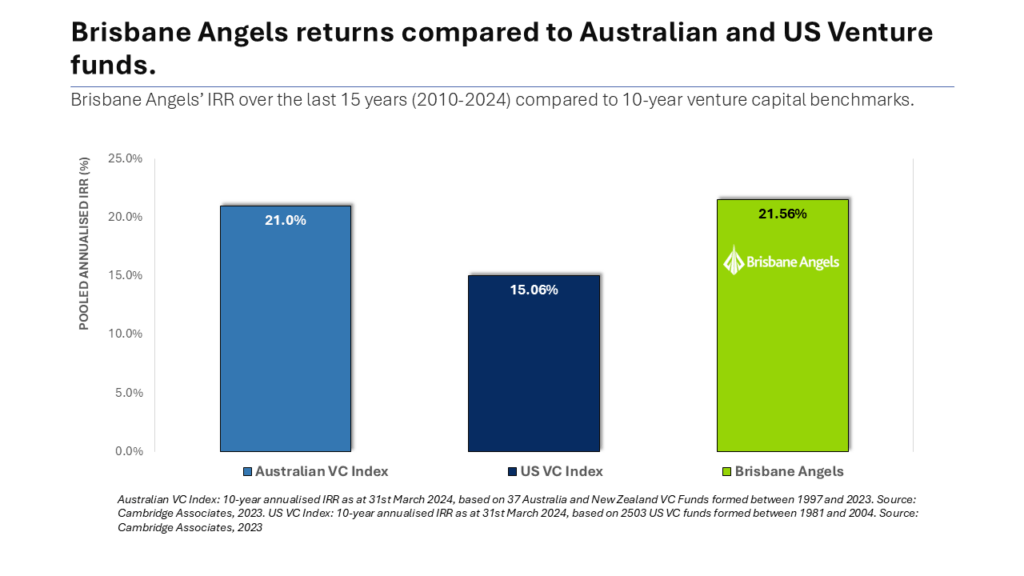
Recent Australian data shows that Brisbane Angels have delivered a return of 22%, which is on par or better than many VC funds. This is thanks to their early entry point (when valuations are lower) and the power of diversification. Investing early allows angels to get a bigger share of the company at a lower price, which amplifies returns if the business succeeds.
VC funds typically aim for an internal rate of return (IRR) of 20-25%, but many fall short due to high fees, longer timelines, and later entry valuations. VCs also face pressure to deploy large amounts of capital, sometimes into overvalued rounds, which can dilute potential returns.
In contrast, angels who build a portfolio of 25+ companies using smart investment cadence (e.g. one investment every 1-3 months) can mitigate risk and position themselves for outsized returns. The key lies in the maths: if one or two investments return 20x or more, they can cover losses on the others and generate a significant portfolio return.
Another benefit of angel investing is the earlier liquidity event. Angels can sometimes exit in earlier rounds or through secondary sales when VCs enter. This provides optionality and shorter exit timelines compared to VC funds, which often hold for 8-10 years.
So, when weighing angel investing vs venture capital, the smart investor sees that well-structured angel portfolios offer compelling risk-adjusted returns. You don’t need to be a tech mogul or full-time investor to benefit. You just need a plan, a patient cadence, and access to quality deal flow.
An accessible and lucrative option for investors
Angel investing is no longer the domain of insiders. With the right education, structure, and access to vetted deals, sophisticated investors can build diversified portfolios that rival and even outperform venture capital returns. If you’re ready to start your journey into early-stage investing, it might be time to roll the dice with a strategy that tilts the odds in your favour with MooCoo Ventures.
www.moocoo.vc