

Investing in early-stage startups is an exciting and enticing prospect, but it isn’t for everyone.
The risk is significant, and the rewards can be astronomical or non-existent. The world of angel investing is not just about financial returns; it’s about being at the forefront of innovation and having a stake in the future of technology. Legendary angel investors like Jason Calacanis, who transformed a $25,000 seed investment in Uber into over $100 million, exemplify the high-risk, high-reward nature of this investment strategy. Calacanis’s investment returned 5,000x, making him a household name in the investment community. Similarly, Gary Tan’s $300,000 seed investment in Coinbase turned into $680 million (2,000x), and Keith Rabois’s $380,000 investment in Airbnb was worth $600 million (1,500x) at IPO.
In Australia, Blackbird’s first investment in Canva yielded 2,600x, creating 100 new millionaires. These stories illustrate the potential of angel investing but also underscore the rarity and difficulty of achieving such outcomes. So what drives these investors to take such significant risks and how do they navigate the turbulent waters of early-stage investing?

The prized returns today’s angel investors seek “If you find yourself in a privileged enough position to take such a risk, the bets that pay off biggest are the bets you take before anyone else is ready to.” Alan Jones, early investor in Canva via Blackbird VC.
In the 1990s, investors were inspired by Peter Lynch’s strategy of seeking “ten baggers”, investments that could return 10 times their initial value. Achieving a 10x return was considered a significant triumph. However, in today’s tech-driven world, the stakes have risen dramatically. Angel investors now hunt for “unicorns”—startups valued at over $1 billion—that can return more than 30x their initial investment. In some cases, these unicorns can yield returns exceeding 100x, akin to winning the lottery. In their search for unicorns, investors consider a particularly high risk/high reward form of investing called angel investing.
What exactly is angel investing?
An angel investor is someone who provides capital to startup companies for some equity. Angel investment is usually the first money injected into a startup after the entrepreneur’s personal capital, friends and family. Angels bridge the funding gap to venture capital, the first institutional capital a startup company can access.
Angel investing is high risk. Most angel investments fail entirely. Diversifying investments is crucial for managing the inherent risks. By spreading capital across multiple ventures, investors can mitigate the impact of any single investment’s failure. This guide will explain key concepts and illustrate the process applied by experienced angel investors so you can decide if this type of investment is right for you.
Risks and Rewards
Australian angel investor Richard Moore enjoys angel investing, and so he should. He is known as one of Australia’s most prolific angel investors, with a 50x partial exit and the possibility of 100x or more for the balance. With about 70 companies in his portfolio as of mid-2024, he’ll continue to back early-stage startups for a long time. After investing in technology companies for over 20 years, he learned that angel investing is mostly a numbers game, or as he describes it, “a positive sum probability game”.
Moore’s experience underscores a crucial lesson – putting all your money into a handful of investments is like gambling on lottery tickets – you’ll likely lose. Instead, Moore advocates for diversifying investments across numerous startups. This approach, grounded in rigorous selection criteria, aims to achieve historical annual returns of 20% to 30%. Occasionally, a single unicorn investment can far exceed expectations, dramatically enhancing an investor’s overall portfolio performance.
Risk Return Data
While risk/return data related to angel investments is somewhat difficult to access, venture funds (a proxy for angel investing) provided the highest returns (and risk) vs several other asset classes.
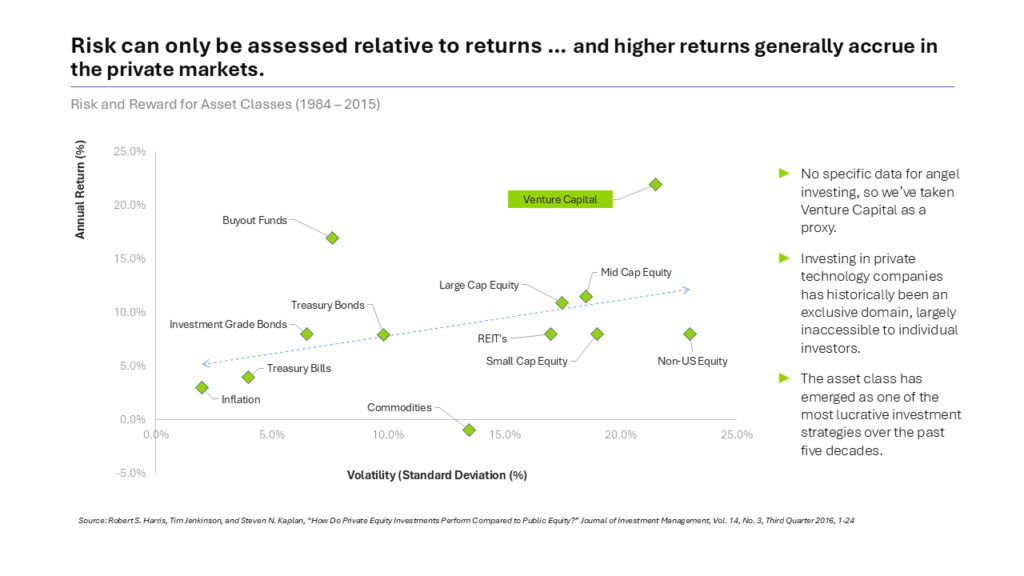
If you are comfortable with high-risk investments, angel investing may be an appropriate option for a modest percentage of net wealth as part of your broader portfolio strategy.
Why become an angel investor?
At its core, angel investing is about identifying high-potential startups, and in today’s market environment, the chances of success are surprisingly favourable if you understand the game. For investors with a high-risk appetite, a passion for making money, and a willingness to invest both social and financial capital, angel investing can be a compelling option.
So why choose angel investing over other forms of investment?
Early-stage tech startup investing is primarily about making high returns. Given the risks, it is also for-profit philanthropy. Investors are attracted to early-stage tech startups not only for the potential financial gains but also for the opportunity to contribute to the entrepreneurial ecosystem and to be recognised for discovering and supporting groundbreaking technology.
Many investors like to support budding entrepreneurs, offer mentorship to up-and-coming talent and make investments that have a meaningful impact on people and the planet. Equally, investors like the novelty. Angel investing can stave off the boredom of retirement and is cheaper than buying a yacht!
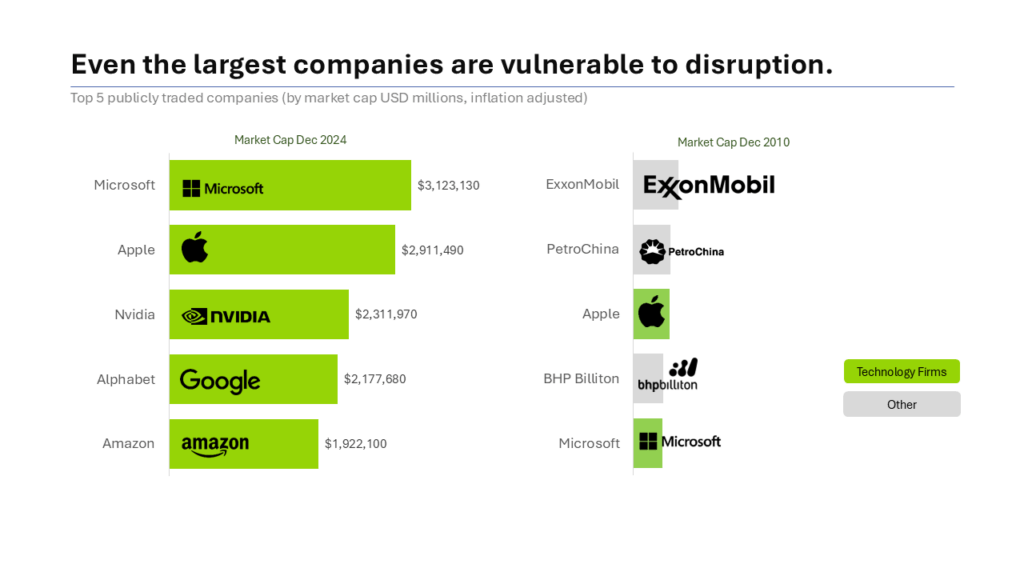
In late 2022, ChatGPT went from a sci-fi AI tool to every university student’s best friend almost overnight. Regulators, educational institutions, and creative professionals have been left scratching their heads and asking, “What just happened?”
While it’s difficult for anyone to keep up with technological advancements like this, angel investors are well-placed to identify and invest in the next generation of technology companies. It’s about navigating the trends shaping technology, creating chances for high-return investments and supporting the tech advancements changing our world.
Angel investors see hundreds of pitches a year. They see entrepreneurs tackling old problems that the latest technology can now solve and new problems that technology is causing. Angels also see new ideas and technologies that might solve tomorrow’s problems. These pitches are a real-time status check on where we are on the exponential technology curve and offer insights into where we might be headed in the coming years.
For those willing to embrace the risks, early-stage tech investing offers a rare chance to be at the forefront of technological innovation. In the next topic, we provide an overview of the key challenges with angel investing. These will be explored in more detail in future posts.